The Beneficiary Mistake That Could Cost Your Family Everything

Most people spend years building their retirement savings. They contribute to their 401(k), IRAs, pensions, life insurance policies, and investment accounts with one goal in mind: to provide financial security for themselves and the people they love.
But there's one simple document that can completely override even the best financial plan.
Your Beneficiary Designation.
It's one of the most overlooked parts of financial planning, yet it determines who receives many of your assets when you pass away. Unfortunately, we've recently experienced two heartbreaking situations in our own office that illustrate why reviewing your beneficiaries should be at the top of everyone's financial checklist.
A Real-Life Reminder
As financial advisors, we have the privilege of helping families prepare for retirement, protect their assets, and plan for the future. While we discuss investments, taxes, insurance, and income planning every day, sometimes the most important conversations involve paperwork that many people haven't looked at in years.
Over the past several months, we've seen two situations that reinforced just how critical beneficiary reviews really are.
Case #1: An Ex-Spouse Was Still Listed
One of our clients was approaching retirement after decades of hard work. Everything was coming together. Retirement was just around the corner.
Tragically, he passed away before he had the opportunity to enjoy the retirement he had worked so hard to achieve.
As his accounts were reviewed, one discovery changed everything.
One of his retirement accounts still listed his former spouse as the beneficiary.
Although his life had changed significantly over the years, that beneficiary designation had never been updated.
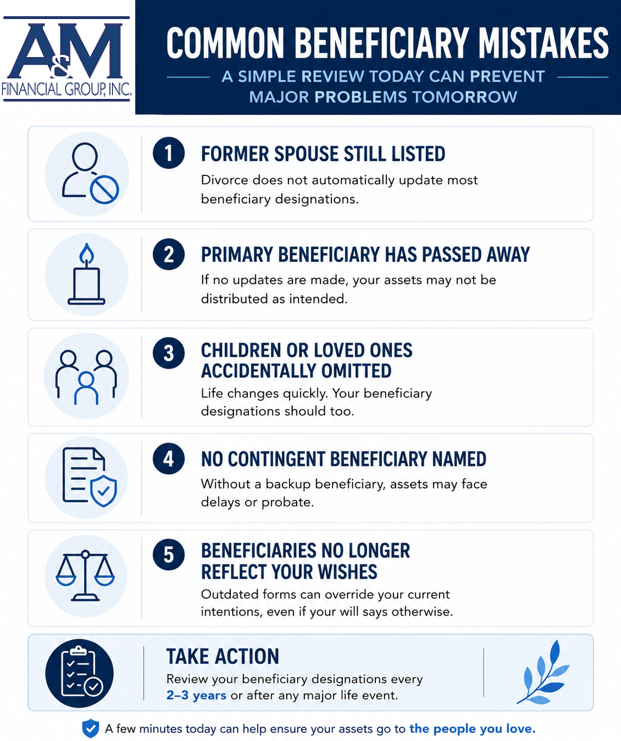
Many people believe that a divorce decree or even a new will automatically changes beneficiary designations. In most cases, it does not.
Retirement accounts, life insurance policies, annuities, and many investment accounts are distributed according to the beneficiary form on file, not necessarily according to your will or your current wishes.
A form completed years ago can determine where hundreds of thousands of dollars ultimately go.
Case #2: No Contingent Beneficiaries
In another recent situation, we had just begun working with a wonderful couple.
Their paperwork was underway, and we were looking forward to helping them organize their financial lives.
Then the unimaginable happened.
Within only a few weeks, before their accounts had even been transferred to our firm, both individuals unexpectedly passed away.
As we reviewed their accounts, we discovered there were no contingent beneficiaries listed.
Without contingent beneficiaries, assets often become far more complicated to distribute. Instead of passing directly to the next intended recipient, some assets may have to go through probate or become part of the estate, creating delays, additional legal expenses, and unnecessary stress for surviving family members.
It was a heartbreaking reminder that beneficiary planning isn't just about who receives your assets. It's about making life easier for the people you leave behind.
Why Beneficiary Reviews Matter

Many people complete beneficiary forms when they first open an account and never think about them again.
But life changes.
- People marry.
- They divorce.
- Children are born.
- Grandchildren arrive.
- Loved ones pass away.
- Relationships evolve.
Yet beneficiary forms often remain exactly as they were decades earlier.
We've seen situations where:
- Former spouses were still listed as beneficiaries.
- Parents who had already passed away remained beneficiaries.
- Children were accidentally omitted.
- No contingent beneficiaries had been named.
- Beneficiaries were listed equally even though circumstances had changed dramatically.
These mistakes are surprisingly common and entirely preventable.
What Assets Have Beneficiaries?
- Traditional IRAs
- Roth IRAs
- 401(k) and 403(b) plans
- Pension survivor benefits
- Life insurance policies
- Annuities
- Transfer-on-Death (TOD) investment accounts
- Payable-on-Death (POD) bank accounts
- Health Savings Accounts (HSAs)
Because these assets generally pass directly to the named beneficiary, keeping those designations current is extremely important.
When Should You Review Your Beneficiaries?
- Marriage
- Divorce
- Death of a spouse or beneficiary
- Birth or adoption of a child
- Birth of grandchildren
- Retirement
- Significant changes in assets
- Estate planning updates
Even if none of these have occurred recently, reviewing your beneficiary designations every two to three years is simply a good financial habit.
A Simple Review Can Prevent Major Problems
One of the easiest things you can do to protect your family isn't buying another investment or changing your portfolio.
It's making sure your beneficiary designations accurately reflect your wishes.
A beneficiary review typically takes only a few minutes, yet it can prevent confusion, family conflict, unnecessary legal expenses, and delays during one of the most difficult times your loved ones will ever face.

We're Happy to Help
At AMFG Wealth Management, we believe good financial planning isn't just about growing your wealth. It's about making sure your wishes are carried out exactly as you intend.
That's why we're offering a complimentary Beneficiary Review.
We'll help you review your current beneficiary designations, identify potential issues, answer your questions, and help ensure your assets are positioned to transfer according to your wishes.
There is no cost and no obligation.
Request Your Complimentary Beneficiary Review Today
Don't wait until it's too late to discover a mistake that could have been corrected in just a few minutes.
Click below to request your complimentary Beneficiary Review:
https://amfinancialgroup.org/beneficiary-review/
Your retirement plan is about more than building wealth. It's about protecting the people you love. Making sure your beneficiary designations are current is one of the simplest and most valuable steps you can take.